That's not just noise. That's a Cessna at 640 feet with no required insurance.
Every hour, a few small training and private planes cross this neighborhood below the FAA's minimum altitude for populated areas. If one loses its engine, the pilot has seconds and only a few blocks to choose where it comes down. If it lands on a house, no law guarantees there's a policy to pay for it.
Low altitude turns an engine failure into a forced landing among houses
// engine-out reachable areaA small plane that loses power becomes a glider. It can only land somewhere inside its glide range, which pilots call the engine-out reachable area. That range shrinks in step with altitude.
Over open land, a short glide still leaves options. Over a grid of rooftops, power lines, and parked cars, it may leave none. That is why the FAA sets a 1,000-foot floor above the highest obstacle within 2,000 feet when flying over congested areas.
Two caveats. The rule doesn't apply during takeoff and landing, and our receiver logs barometric altitude, not height above the nearest roof. A low reading is a reason to look closer, not proof of a violation. See the reachable-area diagram.
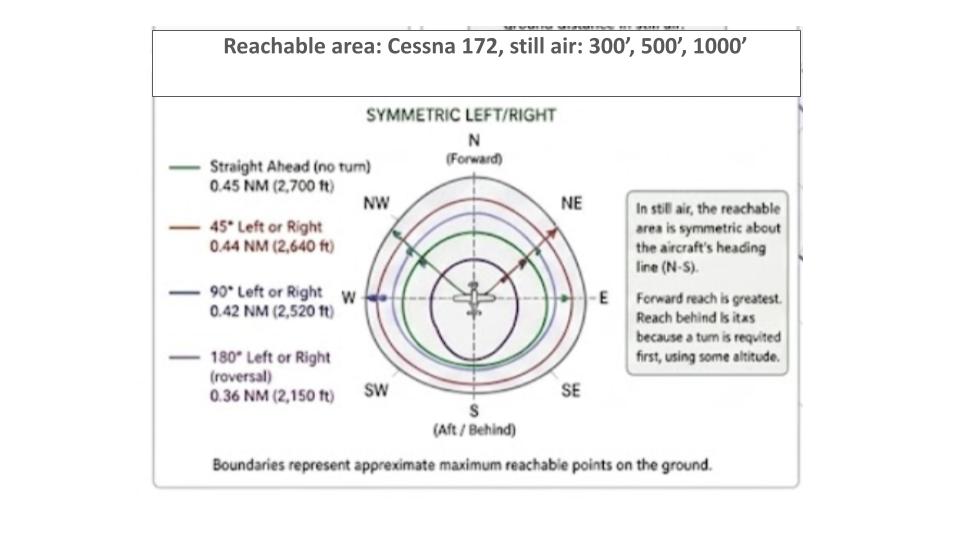
| Altitude | Max reach | Over this neighborhood |
|---|---|---|
| 300 ft | ≈ 0.45 nm | A few blocks, no time to turn Below floor |
| 640 ft | ≈ 0.95 nm | Commonly logged here Below floor |
| 1,000 ft | ≈ 1.5 nm | Roughly the legal minimum |
| 1,800 ft | ≈ 2.7 nm | Room to reach open ground or the field |
More of LGB's small-plane traffic now circles the neighborhood instead of leaving it
// FAA OPSNET · general aviation · 2005–2025The total number of small-plane operations at LGB is back to where it was twenty years ago. What has changed is the mix. Local operations are aircraft that stay in the airport's traffic pattern, mostly training flights practicing takeoffs and landings. They grew from about 173,000 a year to almost 218,000. Flights that actually travel somewhere fell by more than a quarter.
Pattern work means the same aircraft flying the same low circuits over the same blocks, many times an hour, at the altitudes where an engine failure leaves the least room. The 2023 hangar-roof crash happened during exactly this kind of flight.
Source: FAA Air Traffic Activity System (OPSNET), Airport Operations for LGB, calendar years 2005–2025. Counts cover hours the control tower is open, so true totals are slightly higher.
The state of insurance for small planes flying around LGB
// who paysIf a car hits your house, California's mandatory auto insurance almost always means there's a policy to claim against. Aircraft don't work that way. Here is how coverage stacks up, from Washington down to the airport.
Federal · FAA
Not requiredThe FAA doesn't require liability or hull insurance for privately owned general aviation aircraft. Federal insurance minimums apply to air carriers, not to a private pilot or a rented Cessna.
State · California
Only after a crashCalifornia's Uniform Aircraft Financial Responsibility Act doesn't make private owners carry liability insurance. The state Supreme Court confirmed this in Escobedo v. Estate of Snider (1997). Owners only have to show they can pay after an accident has already happened.
State · Commercial operators
Low, rarely enforcedA separate statute covers commercial air operators, with minimums of $100,000 per passenger seat, $300,000 for injuries to people on the ground, and $100,000 for property damage. The state utilities commission says it enforces that order only for commercial balloon flights. The amounts are also small next to the cost of a destroyed home.
Long Beach Airport
Terms not publicLGB's 2017 Minimum Standards require FBOs, flight schools, and rental operators to carry insurance, but the amounts are set in each operator's private agreement with the City. The published standards list no figures. Private, non-commercial aircraft aren't covered by these standards at all.
The insurance market
Voluntary, cheap, plentifulMost owners do buy coverage, often because a lender or hangar landlord requires it. A common policy is $1 million per occurrence with a $100,000 sublimit per passenger. Coverage is inexpensive right now: broker WTW expects general aviation rates to stay flat or fall up to 5% heading into 2027. Cost is not the reason coverage stays thin.
The gap
A private plane can legally fly over this neighborhood with no insurance at all, and a fully insured one may carry a limit that wouldn't rebuild a single house. If a plane damaged a home or hurt someone, the injured party would usually have to pursue the pilot and owner directly. Any policy caps what the insurer pays, and everything above it depends on the personal assets of the people involved. Neighbors on the ground have no way to know which kind of plane is overhead.
This has happened here
// incidents at and near LGB- JUL 2023Cessna 172 into a hangar roof
A pilot practicing takeoffs and landings crashed nose-first into the roof of a maintenance hangar on the south side of the airport. He was alone and had minor injuries; about 45 gallons of fuel leaked.
- 2015Beechcraft Musketeer into the Lakewood Blvd fence
Landing on Runway 25R, the plane hit the perimeter fence along Lakewood Boulevard. Debris struck a passing driver's car, and the road closed overnight for wreckage and a fuel leak.
- MAY 1979Crash in a residential area
Two people died when their small plane crashed in a residential neighborhood near Long Beach Airport.
None of these became a mass-casualty event, and the 2015 crash came within feet of a public road. Each shows how close to people these aircraft operate.
Turn a low flight into a record someone has to answer
// what neighbors can doIdentify the aircraft
Open the live map and tap the plane. Note the tail number, time, and altitude. Flights below the floor show in red.
Report it to the FAA
Use the FAA Hotline or contact the local Flight Standards District Office, which can investigate a specific flight.
Report noise to the City
Long Beach takes reports through its Neighborhood Noise Concern form.
Ask what flight schools carry
A California Public Records Act request can ask for the insurance minimums and certificates in LGB's agreements with flight schools and rental operators.
Ask the Council to publish the numbers
The Minimum Standards could list required liability limits for training and rental operators, as many other airports do.